
[1] Chromium — Fact Sheet for Health Professionals
National Institutes of Health, Office of Dietary Supplements.
View sourceA clear separation between the manufacturer’s proposed metabolic-support positioning and what independent ingredient research actually supports.
Reviewed and updated: September 22, 2026
The product is marketed as a liquid daily formula intended to support healthy glucose metabolism, blood sugar balance, energy and metabolic wellness.
Published research can help explain why certain ingredients are used, but it cannot establish that the finished Glyco Barrier formula produces a specific clinical effect unless the finished product itself is tested.
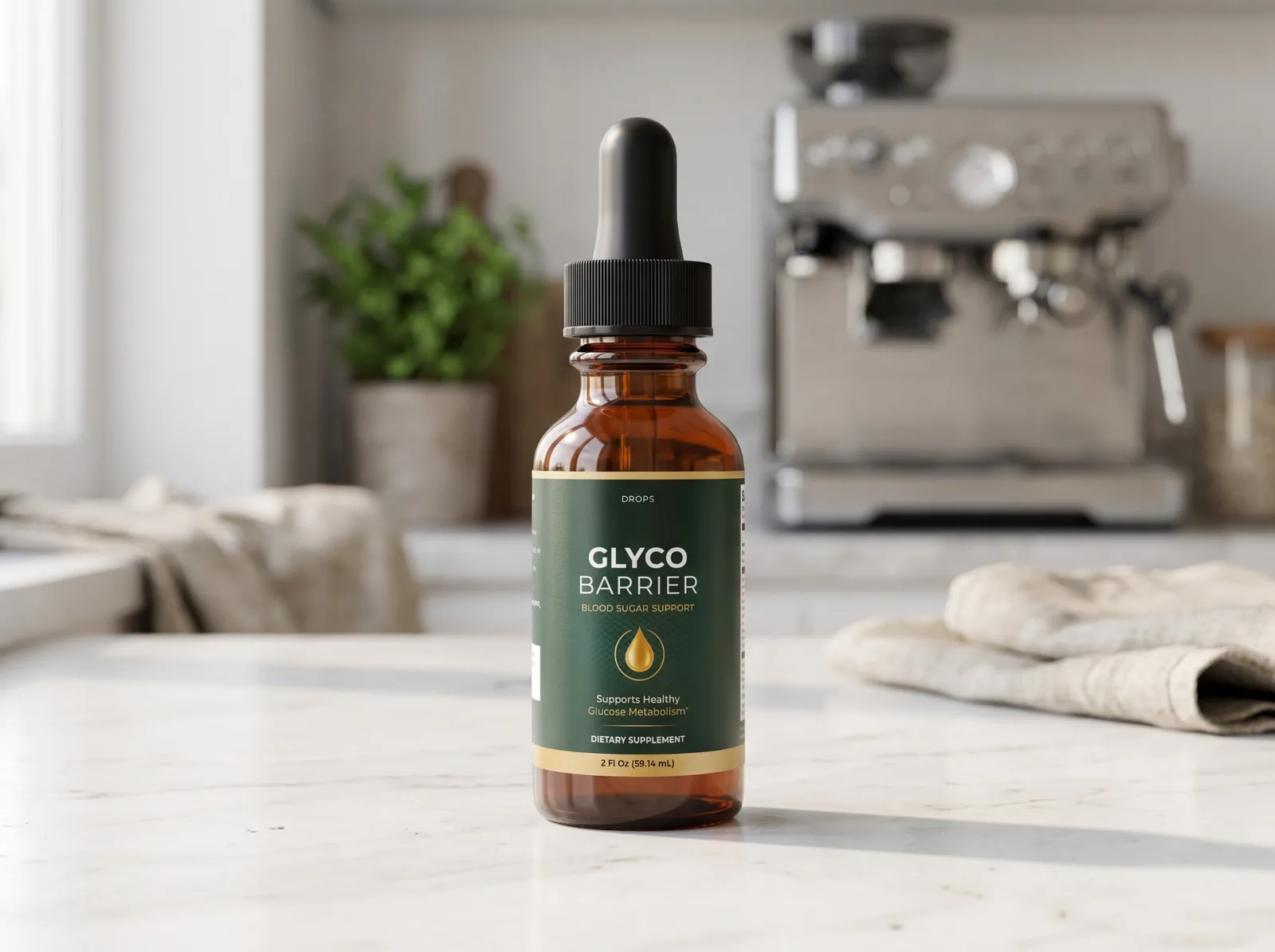
Blood glucose is regulated by multiple systems, including digestion, insulin secretion, insulin sensitivity, liver glucose output, muscle uptake, physical activity and overall diet. A dietary supplement cannot be evaluated responsibly by looking at one pathway in isolation.
For a formula like Glyco Barrier, the scientifically relevant question is whether its individual ingredients have credible human evidence connected to glycemic markers—and whether the finished product contains comparable forms and amounts. The first question can be partly researched; the second is limited by the proprietary blend.
The NIH notes that chromium may play a role in carbohydrate, lipid and protein metabolism and may influence insulin action, although the precise mechanism is not fully established.[1]
This makes chromium conceptually relevant to a glucose-metabolism supplement. However, clinical results are mixed across populations, and the public product description we reviewed did not provide the chromium amount needed for a dose-to-study comparison.
Gymnema is one of the more directly relevant botanicals in the formula’s glucose-oriented positioning. A systematic review and meta-analysis found changes in several glycemic markers, but also reported substantial heterogeneity between studies.[3]
The most responsible interpretation is that Gymnema has a meaningful research history in glycemic control—not that Glyco Barrier has been clinically proven to lower blood sugar.
A 27-trial meta-analysis found a small reduction in fasting glucose but no significant overall effect on fasting insulin or HbA1c.[5] Different green-tea preparations vary substantially.
A meta-analysis of Panax trials found a modest fasting-glucose effect but not consistent changes across other glycemic markers.[7] Glyco Barrier does not specify the ginseng species in the description reviewed.
The product description states that the proprietary herbal blend totals 200 mg and contains 20 ingredients. That is a total blend amount, not 200 mg of each ingredient. Without the individual amounts, a study using hundreds of milligrams of a single standardized herb cannot be treated as a dose match for Glyco Barrier.
The same issue applies to extract chemistry. “Green Tea Leaf Extract” can differ in catechin and caffeine content; “Ginseng Root” can refer to different species; and “Maca Root” can vary by preparation and variety. Those distinctions affect how directly a paper can be related to a commercial formula.
The manufacturer markets the liquid format as fast absorbing. A liquid delivery format can be convenient for people who prefer not to swallow capsules, but we did not identify a head-to-head pharmacokinetic study showing that Glyco Barrier itself produces superior absorption or outcomes compared with capsule formulations.
Best direct evidence for the exact formula. We did not identify one for Glyco Barrier.
Useful for understanding an ingredient category, but preparation and dose still matter.
Helpful when the ingredient identity and dose are comparable.
Useful for understanding intended use, but not independent proof of efficacy.
We did not identify a published clinical trial evaluating the complete Glyco Barrier formula as sold. The research cited here concerns individual ingredients or specific standardized preparations, sometimes in populations with diabetes or impaired glucose tolerance.
That distinction matters because the proprietary blend does not reveal the dose of each botanical and because an ingredient can behave differently when used at another dose, in another extract, or in combination with many other ingredients.
National Institutes of Health, Office of Dietary Supplements.
View sourceDevangan S, Varghese B, Johny E, Gurram S, Adela R. Phytotherapy Research. 2021;35(12):6802–6812. DOI: 10.1002/ptr.7265.
View sourceXu R, Bai Y, Yang K, Chen G. Nutrition & Metabolism. 2020;17:56. DOI: 10.1186/s12986-020-00469-5.
View sourceShishtar E, Sievenpiper JL, Djedovic V, et al. PLOS ONE. 2014;9(9):e107391. DOI: 10.1371/journal.pone.0107391.
View sourceManufacturer/marketer product page reviewed September 2026. Used for formula, directions, package and guarantee statements; commercial claims are treated as manufacturer-reported.
View source